Lift
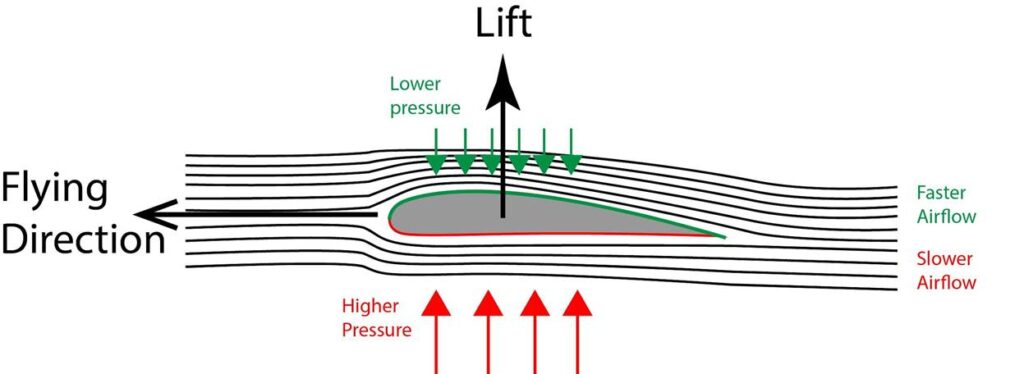
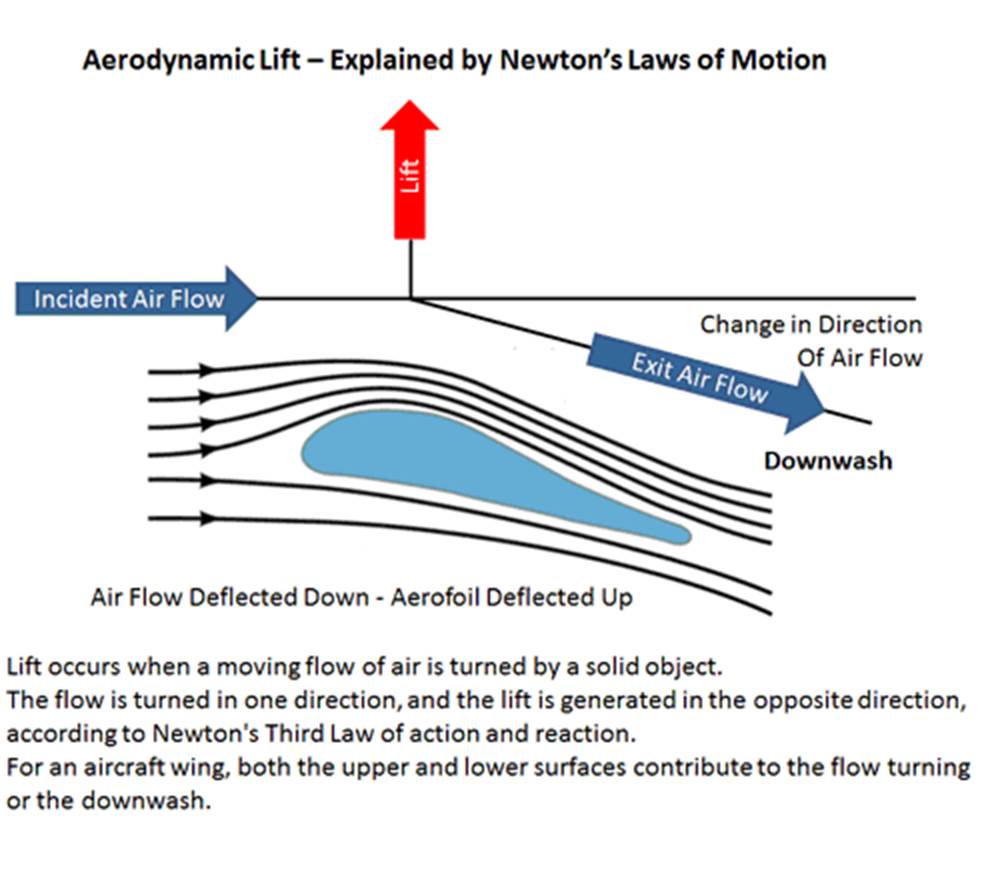
Lift is generated by the airfoil (wing) of an aircraft. As air flows over an airfoil, some air travels above it, naturally, and some air travels below it. The curved surface of an airfoil and the angle of attack of an airfoil will cause the air above to travel faster than the air below. Bernoulli’s principle explains that the faster that air travels, the lower the pressure it will exert on the surface on which it is traveling. This means that the air traveling on the top of the airfoil exerts less pressure on the wing itself than the air on the bottom. This difference in pressure generates lift. Plus, the airfoil simply deflecting air downwards also generates lift.
If you are ever sitting in an airplane, especially a large one, and have a window seat, you will notice that as the plane picks up speed for takeoff, the wing will start to flex upwards. As the plane is gaining speed, there is more air flowing over the wing, and that low pressure area is getting larger and larger, lifting the wing.
There are some myths regarding why the airflow over the top of an airfoil is faster than underneath. Some explanations say that it is because the air has to travel more distance over the top of the airfoil than the bottom, so the air moves faster to basically meet the bottom air at the end of the airfoil at the same time. This is known as the Equal Transit Time Theory, which is false. The air over the top usually makes it to the back of the airfoil faster than the air on the bottom does. Another myth is that lift only comes from the curved surface of an airfoil. This is also false. Even a flat plate will generate lift because it deflects air downwards. The curved surface of an airfoil definitely helps, and airplanes are designed with this in mind, but it is not the only factor at play.
Sources: